China’s DTH hammer industry offers many efficient designs, yet field performance can change quickly. A hammer that delivers strong blows in the morning may sound weak by afternoon. The question is practical: why do DTH hammers lose impact energy?
Lars Eriksson, a field drilling engineer specializing in down-the-hole systems, explains, “Impact energy is rarely lost in one place; it leaks through several small problems.” His observation reflects daily drilling experience. Air pressure may fall before reaching the hammer. Worn piston surfaces can reduce the stroke. Contaminated air can damage seals and valves. Incorrect bit clearance also absorbs useful impact force. Small losses accumulate.
It is not always the hammer’s fault.
This introduction examines China’s top ten DTH hammers through that wider technical lens. It considers piston wear, air consumption, valve timing, lubrication, shank condition, and compressor matching. It also connects laboratory specifications with visible field details, such as slower penetration, irregular exhaust, excessive vibration, or unusual steel temperature. These signs matter because catalog energy figures rarely describe every rock formation or working depth.
A deeper issue deserves attention. Operators sometimes increase air pressure to recover lost performance. That response can increase wear without restoring real impact energy. The better approach involves measuring pressure near the hammer, checking the flushing path, and inspecting internal parts regularly. Still, no ranking can remove every uncertainty. Rock hardness, drilling angle, maintenance habits, and operator judgment remain important. This article therefore compares product capability, not promises perfection. Real drilling is less tidy.
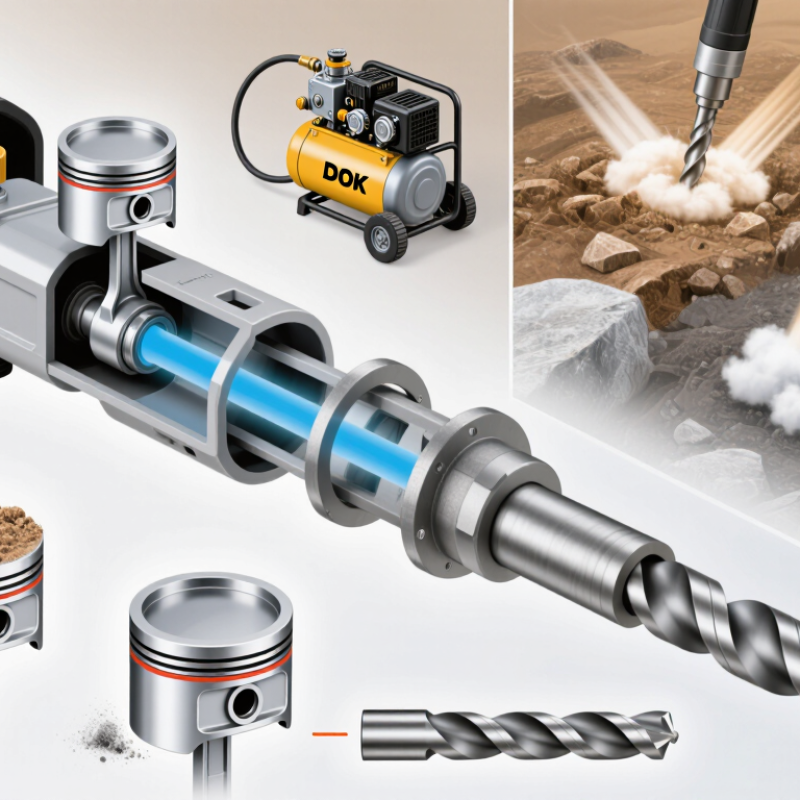
China Top 10 DTH Hammers: Why Do They Lose Impact Energy?
A down-the-hole hammer converts compressed-air pressure into piston movement. The piston strikes the drill bit directly inside the hole. This short energy path reduces transmission loss compared with long-string impact systems. Typical field settings use 17–25 bar working pressure and 20–30 blows per second, according to operating ranges reported in drilling engineering manuals and field studies. The actual impact energy depends on piston mass, stroke length, timing, and backpressure.
Airflow does more than drive the piston. It also returns cuttings through the annulus. When the hole is too narrow, airflow becomes restricted. Backpressure rises, and the piston loses acceleration. A 2023 review in Rock Mechanics and Rock Engineering identifies pressure losses, poor flushing, and bit-rock contact as major causes of declining drilling efficiency. The loss may appear small. It is not.
Our first calculation is often wrong. Gauge pressure is not impact energy. A worn piston seal can leak air before the piston reaches full speed. Excessive water can also cushion the strike. In field testing, engineers should record pressure at the hammer, not only at the compressor. The U.S. Department of Energy’s mining efficiency reports repeatedly stress measured airflow, leakage control, and system-level testing. A clean hose does not guarantee a clean energy transfer. Sometimes, the hammer is healthy, but the drilling circuit is not.
| No. | Energy-Transfer Stage | Typical Engineering Data | How Impact Energy Is Transferred | Common Reason for Energy Loss | Practical Check |
|---|---|---|---|---|---|
| 1 | Compressed-air supply | Common operating pressure: approximately 17–30 bar, depending on hammer design and compressor capacity | Compressed air accelerates and returns the piston, providing the energy required for repeated impacts. | Insufficient pressure, excessive pressure drop, undersized hoses, or restricted filters reduce piston acceleration. | Measure pressure at the hammer inlet while drilling, not only at the compressor outlet. |
| 2 | Piston kinetic energy | Impact energy is governed by E = ½mv²; piston velocity has a squared effect. | The moving piston strikes the impact surface and converts kinetic energy into a stress wave. | Low air pressure, incorrect cycle timing, worn seals, and internal leakage reduce piston velocity. | A small reduction in piston speed can cause a disproportionately large reduction in theoretical impact energy. |
| 3 | Impact frequency | Many DTH hammers operate roughly within 1,000–2,000 blows per minute, depending on size and air conditions. | Each blow transfers a stress pulse through the bit to the rock; drilling power depends on energy per blow and blow frequency. | A high frequency with weak blows may indicate inadequate piston travel or restricted airflow. | Compare actual drilling rate, sound, and penetration response rather than judging performance by frequency alone. |
| 4 | Drill-string alignment | The piston, impact surface, bit, and drill string should remain on a common axis. | Axial alignment allows the compressive stress wave to travel efficiently through the impact train. | Bent drill pipes, excessive feed pressure, poor mast alignment, or uneven coupling faces create bending and friction losses. | Inspect rod straightness, coupling shoulders, shank contact pattern, and mast alignment. |
| 5 | Impact-face condition | Impact faces must be flat, clean, and free from deep dents, cracking, or raised metal. | A flat contact surface distributes the piston stress pulse across the intended area. | Peening, pitting, mushrooming, or contamination causes partial contact and reflects more energy. | Check contact marks during every rod change and remove raised material according to service limits. |
| 6 | Bit-to-rock coupling | The bit must maintain firm contact with the rock during the impact event. | The bit transmits the stress wave into the rock, where it creates fractures and chip separation. | Insufficient feed force, bit bounce, voids, or unstable ground interrupt the stress-wave path. | Adjust feed force until the hammer operates without audible bouncing or irregular impact noise. |
| 7 | Lubrication film | Lubrication is normally supplied continuously through the compressed-air stream; the required oil rate is hammer-specific. | Correct lubrication reduces sliding friction and protects the piston, cylinder, and seals. | Too little oil increases friction and wear; excessive or unsuitable oil can damage seals or restrict passages. | Verify oil type, injector operation, and delivery rate against the hammer service specification. |
| 8 | Internal sealing | Piston seals and close-fitting internal surfaces control the timing and direction of airflow. | Controlled air passages create the pressure difference that drives the piston through its working cycle. | Worn seals, scored cylinders, and excessive clearances allow air to bypass the piston. | Look for abnormal air consumption, reduced frequency, poor penetration, and damaged internal surfaces. |
| 9 | Exhaust and flushing | Flushing air must remove cuttings from the hole without creating excessive back pressure. | Exhaust air both completes the piston cycle and carries drilled material out of the hole. | Blocked passages, excessive water, poor annular clearance, or inadequate airflow increase back pressure. | Monitor return flow, cuttings removal, hole cleaning, and compressor pressure stability. |
| 10 | Bit and rock compatibility | Button shape, gauge condition, rock strength, abrasiveness, and fracture behavior determine drilling response. | The bit converts the stress wave into localized compressive and tensile fractures in the rock. | Wrong button profile, worn gauge, over-drilling in hard rock, or excessive rotation wastes impact energy. | Inspect button wear, gauge diameter, penetration rate, torque, and the size of returned cuttings. |
Note: The pressure and impact-frequency figures are representative operating ranges for industrial DTH drilling. Actual values vary with hammer size, piston design, compressor performance, drilling diameter, rock conditions, and manufacturer service limits.
It uses compressed air to move a piston. The piston strikes the bit inside the borehole. This short path can reduce energy loss. Not always, though.
Typical working pressure ranges from 17 to 25 bar. Impact frequency often ranges from 20 to 30 blows per second. Piston mass, stroke, timing, and backpressure also matter. Numbers alone are not enough.
Narrow holes restrict airflow around the drill string. Backpressure then rises, slowing piston acceleration. Cuttings may return slowly. The sound can become dull.
Compressor pressure may differ from pressure at the hammer. Long hoses, bends, leaks, and crushed sections create losses. Measure pressure near the hammer. An early calculation can be wrong.
Worn seals can leak air before full piston speed develops. Scored pistons, blocked exhaust ports, and poor alignment also matter. Too much water may cushion the strike. Too little lubricant increases wear.
Record pressure, airflow, rotation speed, and penetration rate at the same depth. Inspect hoses, seals, piston surfaces, and exhaust passages. Test one variable at a time. Keep a simple log.
Not reliably. Higher pressure may increase heat, leakage, or component damage. Find the restriction or worn part first. I would not use pressure as a shortcut.
Hard, abrasive rock can require different impact patterns than fractured rock. Bit condition, shank fit, airflow, and hole depth must match the formation. A strong hammer can still underperform. That part is easy to overlook.
They provide a starting point, not a guarantee. Compressor capacity, hole depth, rock abrasiveness, and operator adjustment change results. Verify the figures with field measurements. Catalog numbers can disappoint.
DTH hammers transfer impact energy through a sequence of compressed-air pulses that drive the piston against the drill bit. This article examines the top 10 Chinese DTH hammers by focusing on practical design features such as piston structure, air distribution, flushing passages, material strength, and compatibility with different drilling conditions. It also explains why do DTH hammers lose impact energy, including air leakage, worn internal parts, insufficient compressor pressure, blocked passages, poor lubrication, incorrect shank matching, and excessive drilling resistance.
To restore performance, the article presents a step-by-step diagnostic process: check the air supply, inspect connections and seals, evaluate piston and cylinder wear, confirm flushing efficiency, and test operating parameters. Proper lubrication, regular cleaning, timely replacement of damaged components, correct feed pressure, and suitable rotation settings can help maintain stable impact power, improve penetration, reduce downtime, and extend hammer service life.

 Savvy Tools